
Latest Articles
-
Dec- 2022 -5 DecemberDNA
Chemists Discover Why Synonymous DNA Mutations Are Not Always Silent
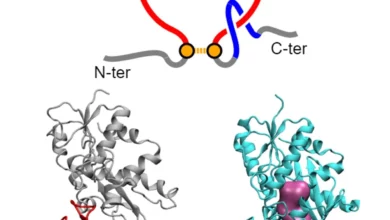
Lead Image: Illustration of a new class of protein misfolding called a non-covalent lasso entanglement that can result from changes to the rate of protein synthesis caused by synonymous mutations. Bottom: structure of a protein showing its native state and misfolded state with non-covalent lasso entanglement. Credit: Yang Jiang, Penn State Modeling shows how genetic changes that don’t lead to changes in protein sequence can still alter protein function. New modeling shows how synonymous mutations — those that change the DNA sequence of a gene but not the sequence of the encoded protein — can still impact protein production and…
Read More » -
5 DecemberEvolution
Just Like Humans – More Intelligent Jays Have This Characteristic
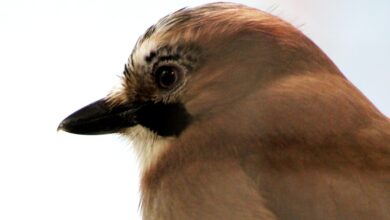
Top of the class was ‘JayLo’, who ignored a piece of cheese and waited five and a half minutes for a mealworm. Credit: Alex Schnell Similar to humans, more intelligent jays display more self-control. According to recent research, Eurasian jays may pass a variation of the “marshmallow test,” and those with the best self-control also do the best on intelligence tests. This is the first proof of a connection between self-control and intellect in birds. Self-control, or the ability to resist temptation in favor of a higher but delayed reward, is a crucial ability that promotes wise judgment and long-term…
Read More » -
3 DecemberNutrition

Scientists Discover That Binge-Eating Sweet Treats Is Influenced by Gut Microbiome
According to new California Institute of Technology (Caltech) research in mice, specific gut bacteria may suppress binge eating behavior. Gut Microbes Influence Binge-Eating of Sweet Treats in Mice We have all been there. You just meant to have a single Oreo cookie as a snack, but then you find yourself going back for another, and another. Before you know it, you have finished off the entire package even though you were not all that hungry to begin with. But before you start feeling too guilty for your gluttony, consider this: It might not be entirely your fault. Now, new research…
Read More » -
3 DecemberAstronomy

Never-Before-Seen Molecule: Webb Reveals a “Hot Saturn” Exoplanet Atmosphere
This illustration depicts the exoplanet WASP-39 b and its star. Credit: Melissa Weiss/Center for Astrophysics | Harvard & Smithsonian New Webb Space Telescope observations of WASP-39 b reveal a never-before-seen molecule in the atmosphere of a planet — sulfur dioxide — among other details. The telescope’s array of highly sensitive instruments was trained on the atmosphere of WASP-39 b, a “hot Saturn” located around 700 light-years away. A hot Saturn is an exoplanet that is about as massive as Saturn and orbits closely to a star such that it has high surface-atmosphere temperatures. Although Webb and other space telescopes, including…
Read More » -
1 DecemberPaleontology
Prehistoric Superpredator: Weird Whatcheeria Was the “T. rex of Its Time”
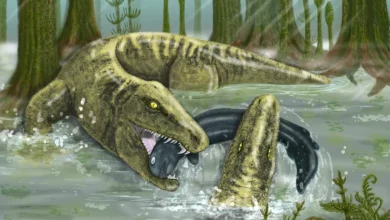
Lead Image: Whatcheeria was a prehistoric superpredator. It was a six-foot-long lake-dwelling creature with a salamander-like body and a long, narrow head. Credit: Adrienne Stroup, Field Museum Ancient Iowan superpredator got big by front-loading its growth in its youth. Fossils found only at the Field Museum reveal the growth history of Whatcheeria. Although the Field Museum in Chicago is famous for SUE the T. rex, it is also home to the best, most-complete fossils of a prehistoric superpredator — one that lived hundreds of millions of years before Tyrannosaurs roamed the Earth. Whatcheeria was a six-foot-long lake-dwelling creature with a…
Read More »