Latest Articles
-
Apr- 2022 -2 AprilNASA
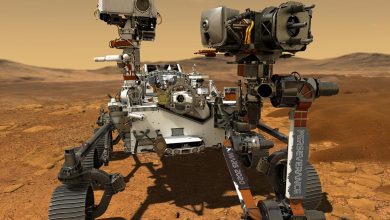
Variable Speed of Sound on Mars: What Sounds Captured by NASA’s Perseverance Rover Reveal About the Red Planet
Lead Image: This illustration depicts NASA’s Perseverance rover operating on the surface of Mars. Credit: NASA A new study based on recordings made by the rover finds that the speed of sound is slower on the Red Planet than on Earth and that, mostly, a deep silence prevails. Listen closely to sounds from Mars, recorded by NASA’s Perseverance: the rover’s mechanical whine and click in a light Martian wind; the whir of rotors on Ingenuity, the Mars helicopter; the crackling strike of a rock-zapping laser. An international team of scientists has done just that, performing the first analysis of acoustics…
Read More » -
1 AprilESA
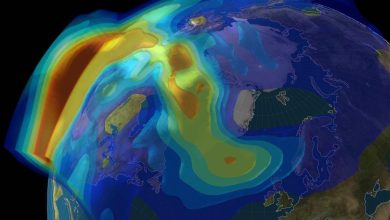
Turn Your Cell Phone Into a Space Monitoring Tool
Model of the well-known October 30, 2003, Halloween solar storm produced by the MIDAS tomographic ionospheric model from the University of Bath. Credit: University of Bath A newly released Android app will turn your smartphone into an instrument for crowdsourced science. Leave it by your window each night with your satnav positioning turned on and your phone will record small variations in satellite signals, gathering data for machine learning analysis of meteorology and space weather patterns. The CAMALIOT app, developed through ESA’s Navigation Innovation and Support Program (NAVISP) with the support of the Agency’s GNSS Science Support Center, is suitable…
Read More » -
1 AprilAtmospheric Science
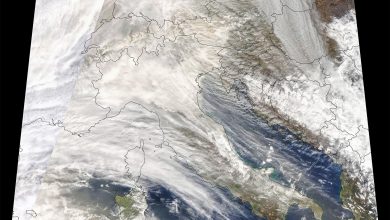
Unusual Dust-Infused Baroclinic Storms Form Over Europe
Lead Image: Dusty Storm Clouds Over Europe March 2022 Annotated Long-lasting, icy cirrus clouds filled with Saharan dust covered many parts of the continent in March. In March 2022, several large storms carried clouds of Saharan dust to Europe. One of them also brought long-lasting, high-altitude cirrus clouds infused with dust, which led to extensive cloud cover—from Iberia to the Arctic—for more than a week. It was an unusual type of storm that scientists have only recently come to understand. Called a dust-infused baroclinic storm (DIBS), its hallmarks are icy clouds permeated with dust. In mid-March, an atmospheric river of…
Read More » -
Mar- 2022 -30 MarchAstronomy
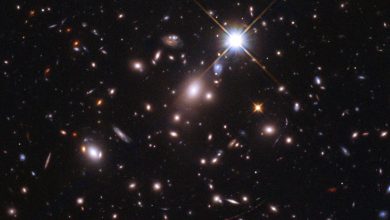
Hubble Spots Farthest Star Ever Seen Thanks to Lucky Cosmic Alignment – “We Almost Didn’t Believe It”
Lead Image: The Sunrise Arc Galaxy With Lensed Star Earendel Credit: Science: NASA, ESA, Brian Welch (JHU), Dan Coe (STScI), Image Processing: NASA, ESA, Alyssa Pagan (STScI) A lucky cosmic alignment has revealed a single source of light in the first billion years after the big bang, setting up a major confirmation for the James Webb Space Telescope in its rookie year. Even NASA’s powerful Hubble Space Telescope can benefit from some assistance, as evidenced in its latest discovery: a record-breaking star so distant that a combination of the telescope’s sophisticated instrumentation and nature’s natural magnifying glass was needed to…
Read More » -
29 MarchNASA
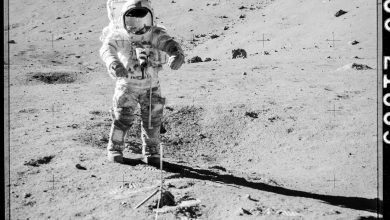
Sealed Apollo 17 Lunar Sample Opened for the First Time – “Incredibly Precious” Scientific Gift
Lead Image: Apollo 17 astronaut Gene Cernan preparing to collect samples 73001 and 73002 on the Moon in 1972. Gene Cernan collected the sample from a landslip deposit that cascaded down into the Taurus-Littrow Valley. The Apollo 17 astronaut hammered a 70 cm long cylindrical tube into the surface to extract a core sample of the lunar soil. Credit: NASA Like a time capsule that was sealed for posterity, one of the last unopened Apollo-era lunar samples collected during Apollo 17 has been opened under the careful direction of lunar sample processors and curators in the Astromaterials Research and Exploration…
Read More »