
Latest Articles
-
May- 2023 -23 MayHealth

Smartphone Diet: How Viewing the Right Food Images Can Curb Your Appetite
Lead Image: A recent study by Aarhus University suggests that looking at repetitive images of food can lead to a sense of satiety, reducing the portion size people choose to consume. The research builds on the grounded cognition theory, suggesting that cognitive perception strongly influences appetite. The results may have implications for weight-loss strategies and the role of food advertisements on social media, particularly given the pervasiveness of food imagery in today’s digital age. Experiment results may lead to a new form of treatment for overeating. Research from Aarhus University has found that repeated exposure to images of the same…
Read More » -
20 MayAI

Virtual AI Radiologist: ChatGPT Passes Radiology Board Exam
Lead Image: The latest version of AI chatbot ChatGPT passed a radiology board-style exam, with the new GPT-4 model correctly answering 81% of questions, up from GPT-3.5’s 69%. However, issues such as struggles with higher-order thinking questions and occasional generation of incorrect responses, pose limitations to its wider adoption in medical education and practice. The most recent version of ChatGPT, an AI chatbot developed for language interpretation and response generation, has successfully passed a radiology board-style exam, demonstrating both its potential and limitations, according to research studies published in the Radiological Society of North America’s journal. The latest version of…
Read More » -
19 MayClimate Change

Antarctica’s Massive Underwater Landslides – Which Could Generate Giant Tsunamis – Caused by Past Climate Change
Lead Image: An international team of scientists has found the cause of giant underwater landslides in Antarctica, which may have triggered far-reaching tsunamis. The researchers identified layers of weak, biologically-rich sediments under the seafloor which, due to their susceptibility to earthquakes and other seismic activity, were behind these landslides. These layers were formed in warmer times, when Antarctica’s temperatures were up to 3°C higher, sea levels were higher, and ice sheets smaller. Scientists have identified weak, biologically-rich sediments beneath Antarctica’s seafloor as the cause of giant underwater landslides that could generate far-reaching tsunamis. These sediments formed in warmer periods and,…
Read More » -
17 MayDNA
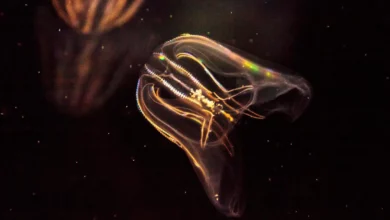
700 Million-Year-Old Family Feud Settled: Genetic Linkages Illuminate Earliest Animal Evolution
Lead Image: A study by MBARI and collaborating scientists used gene linkages to establish that comb jellies, not sponges, are the most distantly related animal to all other animals, helping to clarify a fundamental question about animal evolution that dates back over 700 million years. Mapping gene linkages provides clear-cut evidence for comb jellies as sibling group to all other animals. A groundbreaking study published in Nature by MBARI researchers and their collaborators offers fresh insights into the earliest points of animal evolution, tracing back over 700 million years. The study revolves around the mystery of which animal, sponges or…
Read More » -
15 MayNASA
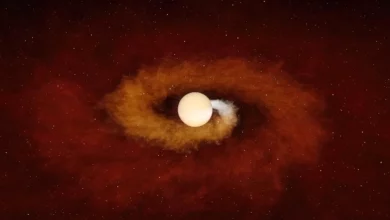
Caught in the Act: Astronomers Detect a Star Devouring a Planet for the First Time
This artist’s concept shows a planet gradually spiraling into its host star. The Jupiter-size planet pulls gas away from the star, sending it into space. There, the gas cools and becomes dust, which is visible to astronomers. Credit: R. Hurt & K. Miller (Caltech/IPAC) A star nearing the end of its life swelled up and absorbed a Jupiter-size planet. In about 5 billion years, our Sun will go through a similar end-of-life transition. In a groundbreaking discovery, astronomers observed an aging star consuming a planet for the first time, providing insights into our Sun’s eventual fate, which will undergo a…
Read More »