
Latest Articles
-
May- 2023 -5 MayClimate Change
The Great Coral Divide: Atlantic Reefs Are Struggling and Indo-Pacific Reefs Aren’t
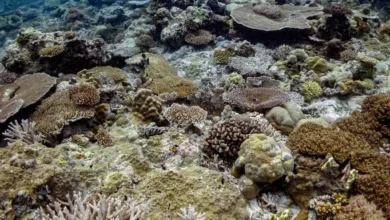
Corals in the Indo-Pacific may be more resilient to climate change than those in the Atlantic, according to a new study describing multiple species of thermally tolerant algal symbionts that enable corals to acquire energy from sunlight. Credit: Allison Lewis In a study exploring the various species of algal symbionts associated with reef corals throughout the Indo-Pacific region, researchers discovered a high degree of flexibility in these relationships. This flexibility may enhance these coral systems’ long-term resilience to climate change’s impacts. Facing the effects of global warming and other environmental shifts, corals in the Atlantic Ocean have experienced a sharp…
Read More » -
4 MayClimate Change
Scientists Discover a Teeming World of Life at the Ice Cap
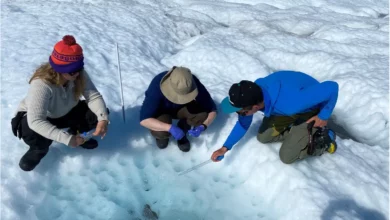
Lead Image: Danish researchers have found more than 4,000 different species of microorganisms in melt holes in the ice like these. Credit: Laura Halbach Greenland’s ice is abundant with life, both above and below its surface. Until recently, science was unaware of the existence of certain microscopic organisms living there. Recent findings even suggest that these tiny creatures are responsible for adding color to the ice and accelerating its melting process. The Greenland glaciers are widely considered as ice deserts, where life is scarce due to the extreme conditions. With the lack of plants and only a limited number of…
Read More » -
3 MayAstronomy
Cosmic Cannibalism: Astronomers Witness Star Devouring Planet in Possible Preview of Earth’s Ultimate Fate
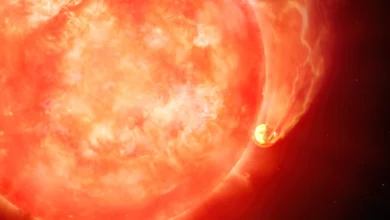
Lead Image: Astronomers using the Gemini South telescope in Chile, operated by NSF’s NOIRLab, have observed the first compelling evidence of a dying Sun-like star engulfing an exoplanet. The “smoking gun” of this event was seen in a long and low-energy outburst from the star — the telltale signature of a planet skimming along a star’s surface. This never-before-seen process may herald the ultimate fate of Earth when our own Sun nears the end of its life in about five billion years. Credit: International Gemini Observatory/NOIRLab/NSF/AURA/M. Garlick/M. Zamani Gemini South captures first direct evidence of an exoplanet being swallowed by…
Read More » -
2 MayHealth

The Power of Prevention: Transforming Healthcare for a Healthier Future
Lead Image: Researchers aim to improve public health policy by advocating for preventive care that reaches people through their community, cultivating preventive healthcare, and increasing access to outpatient elective healthcare for underrepresented groups. Rutgers University is exploring a cutting-edge healthcare model that places a greater emphasis on primary care and preventive measures rather than emergency care in underserved communities. If more individuals have access to health insurance, it is imperative to be sure the death rates of those with certain chronic conditions are decreasing. This is one of the statements Gregory Peck, an associate professor of Rutgers Robert Wood Johnson…
Read More » -
1 MayNASA
Peeking Into the Cosmic Cradle: Webb Telescope Unveils a Massive Protocluster’s Baby Photos
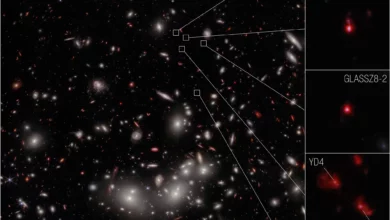
Lead Image: The seven galaxies highlighted in this James Webb Space Telescope image have been confirmed to be at a distance that astronomers refer to as redshift 7.9, which correlates to 650 million years after the big bang. This makes them the earliest galaxies yet to be spectroscopically confirmed as part of a developing cluster. Astronomers used the telescope’s Near-Infrared Spectrograph (NIRSpec) instrument to precisely measure the distances and determine that the galaxies are part of a developing cluster. Galaxy YD4, previously estimated to be at a further distance based on imaging data alone, was able to be more accurately…
Read More »