Latest Articles
-
Nov- 2021 -3 NovemberSpace
Teams evaluate Hubble safe mode event, history of telescope leads to JWST
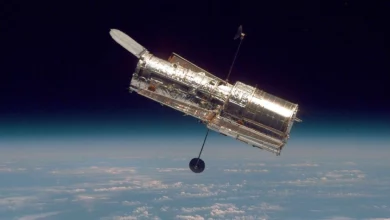
Lead Image: The Hubble Space Telescope. Image Credit: NASA Thirty-one years after its launch, and 12 years after its most-recent servicing mission, the NASA/ European Space Agency (ESA) Hubble Space Telescope remains in safe mode on orbit as operators work to determine why the iconic observatory ceased science operations at 02:38 EDT on October 25. The latest safe mode event continues to publicly show the telescope’s age as its systems gradually deteriorate without servicing — all while NASA, ESA, and the Canadian Space Agency (CSA) prepare for the December launch of a successor to Hubble in the James Webb Space…
Read More » -
3 NovemberSpace - Exoplanets
Scientists Measure the Atmosphere of a Planet in Another Solar System 340 Light-Years Away
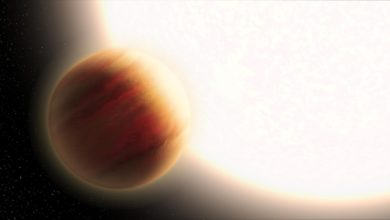
Lead Image: An artist’s concept of a “hot Jupiter” extrasolar planet. Credit: NASA, ESA, and L. Hustak (STScI) An international team of scientists, using the ground-based Gemini Observatory telescope in Chile, is the first to directly measure the amount of both water and carbon monoxide in the atmosphere of a planet in another solar system roughly 340 light-years away. The team is led by Assistant Professor Michael Line of Arizona State University’s School of Earth and Space Exploration, and the results were published in (October 27, 2021) in the journal Nature. There are thousands of known planets outside of our…
Read More » -
3 NovemberScience
Astronauts Often Experience Back Pain – Leading to Treatment Insights for Those of Us on Earth
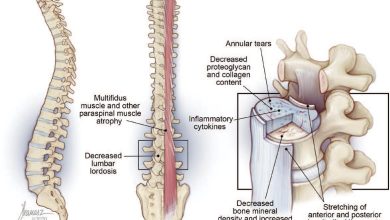
Lead Image: Spinal column on Earth and in space. Credit: Johns Hopkins Medicine Research reviews show back pain affects more than 50% of space travelers. As more people travel into space, Johns Hopkins Medicine experts expect more physicians will see patients with space travel-related pain. Although most back pain in space disappears on its own, space travelers are at higher risk for sciatica — a form of back pain that can radiate down the legs. Humans can “grow” up to 3 inches in space as the spine adapts to microgravity. Stress, trauma, and changes in nutrition likely contribute to back…
Read More » -
3 NovemberScience-Tech
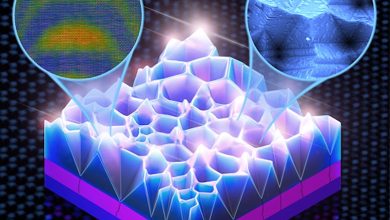
New Way To Generate Light Through Pre-Existing Defects in Semiconductor Materials
Lead Image: A new method of quantum dot fabrication has been demonstrated by making use of intrinsic defects in LED materials. Through the formation of pyramids, localized bright luminescence emanates from the pyramid apexes containing indium-rich quantum dots. Credit: SMART The discovery demonstrates a practical method to overcome current challenges in the manufacture of indium gallium nitride (InGaN) LEDs with considerably higher indium concentration, through the formation of quantum dots that emit long-wavelength light. The researchers have uncovered a new way to generate long-wavelength visible light by making use of intrinsic defects in light-emitting diodes (LEDs), which are used in…
Read More » -
2 NovemberCOVID-19
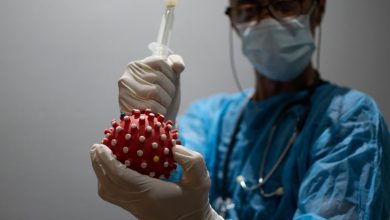
Scientists Target Next Pandemic With Powerful New “Map” to Victory Over Viruses
An international team of scientists has created a powerful new resource to speed the development of vaccines and treatments to battle the next pandemic. University of Virginia School of Medicine researcher Wladek Minor, PhD, and collaborators in China and Poland have developed an Internet information system, called virusMED, that lays out all we know about the atomic structure and potential vulnerabilities of more than 800 virus strains from 75 different virus families, including SARS-CoV-2, influenza, Ebola and HIV-1. Several of the collaborators, including the lead investigator, Heping Zheng, are former students and members of Minor’s lab at UVA. This new…
Read More »